

The tattoo culture has expanded so much that new styles of art and work appear every day. Designs, colors, techniques, and creations are constantly evolving thanks to the creativity and talent of tattoo artists and the adventurous minds of those who entrust their skin to the world of tattooing. But, as in all aspects of life, there is always a beginning. A birth. And, perhaps somewhat whimsically, it could be said that it all began with what is now categorized as old school tattoos, better known as the Old School style.
Getting tattooed: a (formerly) bad American tradition
To talk about what is currently known as old school, one must first go back to traditional American tattooing.
It's well known that 20 years ago, tattoos weren't as accepted in society as they are now . Getting a tattoo wasn't popular. Quite the opposite. Being tattooed was a sign of belonging to a low-esteem social group, generally at odds with the law and with little regard for the traditions accepted by the majority.
This bad reputation in the United States began in the 19th century, when traveling fairs toured the country. At these fairs, the most popular attractions were the freak shows.
These carnivals and circuses presented people with physical or mental problems as entertainment so that people considered "average" at that time would pay dollars to see human beings considered rare or strange.
People with deformities, dwarfism, gigantism, conjoined twins, bearded women, men who endured inhuman pain through being pricked with needles or receiving blows were the main attractions of these fairs that proliferated throughout the United States.
Thus, unfortunately, the tattoo culture of those distant times became linked to a negative image for most people.
Because technology hadn't yet advanced, tattooing techniques at that time were much more rudimentary. The first modern tattoo machine wasn't patented until 1891. Therefore, the main characteristics of this American style are that its pieces are solid, clean, and simple.
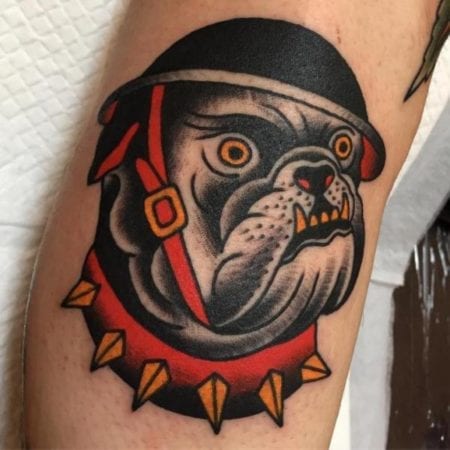
The outer lines of the designs are done in black and with considerable thickness. The color palette is quite limited: black, red, yellow, green, and brown . This is because inks weren't easy to obtain, and there wasn't much variety in the requests of those who dared to get tattoos.
War, a driving force for tattoos
With the arrival of the 20th century, and with the United States already transformed into an industrial country and world power , its Armed Forces began to participate in different armed conflicts around the world.
One way soldiers found to remember battles won , or places they had visited with the troops, was to get tattoos.
Thus, the world of tattooing spread among those who had served their country. Sailors, in particular, were the most fond of tattoos (as had also been the case in the previous century).
So, in this traditional style, marine motifs, or elements such as anchors or ships , became very common, leading to what in the 21st century we know as Old School tattoos.
However, its popularity among soldiers did not help the spread of tattooing . This was because many people who had had run-ins with the law enlisted in the navy to go to sea and forget, for a long time, the land where they had suffered.
Old School Tattoos: everything changes after World War II
Love, patriotism, struggle, nostalgia for the country or a person, and even the vices that helped to get through the calamities of death in war were some of the most recurring themes of those who got tattoos until the 50s.
The soldiers who managed to return alive from the war began to reintegrate into society. Many took to the newly built roads in the United States, riding motorcycles. Thus, motorcycle groups, clubs, and gangs were born . In these groups, it was common to tattoo symbols on their skin that united them and identified them as part of the same philosophy of life. Tattoo culture was beginning to slowly spread.
The Old School style today
Traditional tattooing spread throughout the world and changed its name to Old School tattooing, but maintaining the characteristics of firm, thick strokes and simple designs.
The advantage is that the quality of tattoos has now improved thanks to technological improvements applied to the tools and inks used by professional tattoo artists.
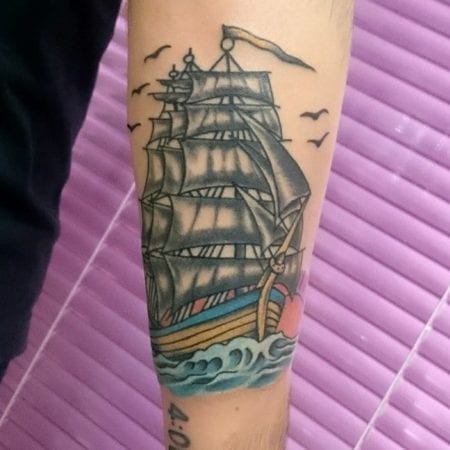
It's common to see someone with an anchor, playing cards, or swallows tattooed in the Old School style. Romantic motifs, pin-up girls , and fierce animals, which convey strength and energy, are also popular.
Old school prehistory
In this article, we'll briefly review the evolution of this style from the late 19th century to the present day. But we mustn't forget that the history of tattooing has many earlier chapters.
Tattooing is an ancient art form. To illustrate with an example: the oldest known tattooing tools are around 3.000 years old and were used by people in Ancient Egypt.
In the city of Abydos, archaeological remains were found that included a sharp wooden point used to make small incisions in the skin. Pigments were then applied to these tiny wounds to mark people's bodies.
At the same archaeological site, they also found what are considered to be the first bronze needles used for tattooing . They are estimated to be about 1.500 years old.